
Australia's Environment Decadal Report 2025
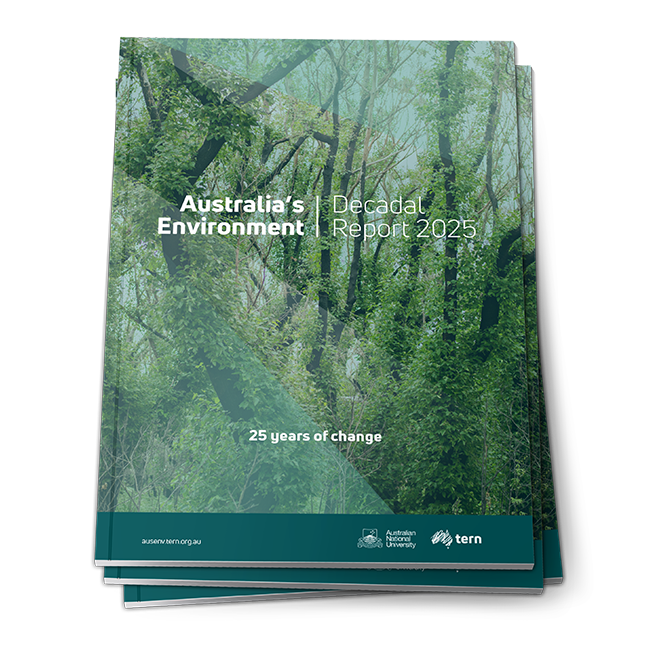
This report summarises 25 years of change in Australia's environment based on national indicators. It shows persistent environmental pressures, limited national-scale improvement, and substantial regional variation.
History of Australia's Environment Report
Over its ten-year life, the Australia's Environment report has evolved into a comprehensive annual assessment of the nation's environmental condition, synthesising large volumes of environmental data into accessible insights. Initiated by Albert van Dijk and the team at the ANU Centre for Water and Landscape Dynamics, the first report for 2015 focused mainly on remotely sensed and model-estimated data, particularly relating to water availability and vegetation condition. In subsequent years, new sections were introduced to broaden the report's scope, covering topics such as global change, human pressures, and the marine environment.
Ecologist Shoshana Rapley joined the team in 2019, bringing expertise on biodiversity, including threatened and invasive species. Production would not be possible without the contributions and publicly available data provided by several national and international government agencies and research organisations. Design and delivery have also advanced. Report production and the interactive data explorer were made possible by the NCRIS-enabled National Computational Infrastructure and developed by Joel Rahman of Flowmatters, joined more recently by Pablo Larraondo Rozas and his team at Haizea Analytics.
Partnering with NCRIS-enabled TERN in 2020 made it possible to expand the report's reach, including further refinement and improved design of the report, website, and data infrastructure. In 2022, biodiversity reporting received a boost from the involvement of Tayla Lawrie of the TERN Threatened Species Index team. Regional environmental scorecards were also introduced along the way to provide more detailed local assessments, increasing the report's relevance to local stakeholders.
Key findings: 2000–2024
 Environmental condition
 Water
Water Global change
 Soils
Soils Oceans
 Vegetation
 People
 Fire
Fire Weather and climate
 Biodiversity
Inside the report

